By Ian Cater
St Albans and District Council stands accused of complacency after failing to follow the lead of other authorities in issuing fines for dog fouling. A spokesperson said the Council had not taken up this power because it does not see dogs’ mess as a “significant or growing problem”.
This is despite plenty of evidence to the contrary, as our accompanying video shows. Indeed, barely a month goes by without a member of popular Facebook group Harpenden Parents Network complaining of dog faeces or – increasingly – discarded poo bags in and around the town.
Veterinary charity PDSA estimates that dog ownership has risen nationally by nearly 10 per cent over the past 8 years. According to Keep Britain Tidy, these 8.9 million dogs produce around 1,000 tonnes of excrement every day.

An unknown Harpenden local makes clear their position on dog poo.
Five years ago, the Government introduced increased powers for councils to issue on-the-spot fines to protect public spaces.
Many, including nearby East Herts District Council, took up these powers, fining owners up to £80 for failing to clean up their dogs’ mess. Some have gone further. In parts of Lincolnshire and Kent, dog walkers can even be fined for failing to have a sufficient number of bags with them.
St Albans and District Council has preferred the carrot to the stick, installing more bins and relying on dog owners to act responsibly.
Its website advises people to report anyone they see “allowing their dog to persistently foul on pavements”. However, a spokesperson admitted the Council had received no complaints in recent memory, perhaps suggesting people do not know how to complain or have little faith their complaints will be acted upon. It is understood the Council has no plans to change its approach.
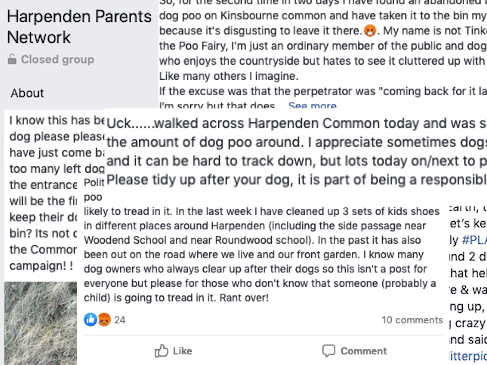
Residents regularly vent their frustrations about dogs’ mess on Harpenden Parents Network.
Harpenden resident Philip Wigg, 41, said this “smacks of complacency”.
The father of three said: “Dog poo on our streets is a growing issue and a problem for hygiene and public health. I cannot understand why the Council doesn’t exercise the powers it has at its disposal to fine dog owners who persistently refuse to clear up after their dogs.”
Enforcing a fining regime could be costly, but would also act as a revenue raiser. For example, three councils in North Wales recently raised a combined £2.1 million over three years in dog fouling and litter fines alone.
There may also be difficulties in identifying culprits, but these are not insurmountable. DNA testing has had some success in the US and Europe, and was trialled recently in Barking and Dagenham. Although it relies on dog owners’ consent, it could serve to deter lazy owners from risking being apprehended.
One thing is for sure: until the Council takes firmer action, Harpenden residents will see dogs’ mess, poo bags and frustrated complaints continue to mount up.
If you see anyone persistently allowing their dog to foul on pavements, you can report this to St Albans and District Council’s Environmental Compliance Team on 01727 819406 or environmental@stalbans.gov.uk.
What’s all the fuss about?
Other than the inconvenience of scraping it off your shoe, is dogs’ mess really a problem?
Well, yes. Canine faeces can carry worms and bacteria, which may transmit to other animals. And, although rare, humans can contract toxocariasis from it – a nasty infection that can lead to dizziness, asthma and even blindness.
Nutrients in canine faeces can also disrupt ecological balance. Earlier this month, East Northamptonshire Council rejected a planning application for housing partly due to fears over the effect increased dogs’ mess would have on a nearby nature reserve.
 Project Refuse