Expert advises South-East sellers to “be realistic” in current housing market

By Ian Cater

A leading money expert has advised people trying to sell property in London and the South-East to “be realistic”.

Simon Lambert, Editor of This Is Money, said in this exclusive interview: “You can’t expect to get the same amount for your property that you were going to get maybe a year ago, so price realistically.”

His comments follow new figures showing a significant drop in the capital’s house prices since this time last year.  Data from the Office for National Statistics (ONS) showed prices in London averaged 4.4 per cent lower in May than at the same stage in 2018.

This is the biggest fall since August 2009 when the banking crisis fallout was found to have taken 7 per cent off London property prices.

Most experts link this latest drop – and the state of the depressed South-East market where prices have risen only marginally – to uncertainty over Brexit and often eye-wateringly high prices in the capital.  The ONS puts the average London property value at £457,000.
IMG_1674

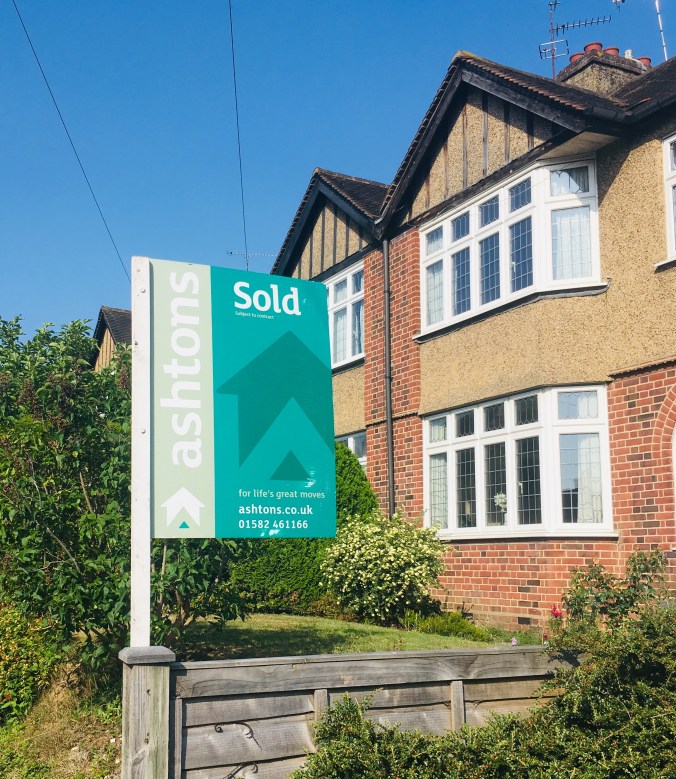
This lucky seller has snared a buyer but others are finding things tougher.

Lambert explained that the inflated market continued to make it difficult for people to get onto the property ladder.  He said many were still struggling “to raise the tens of thousands – maybe even hundreds of thousands – of pounds they need for a deposit, whether that’s to buy their first home or move up the ladder.”

Although he said it is difficult to predict when the situation might change, Lambert offered some signs of hope.  “Banks are very keen to lend at the moment, so mortgage rates are low.  And also there’s talk of a stamp duty cut if Boris Johnson becomes Prime Minister, which might chivvy things along a bit.”

As well as pricing realistically, Lambert advised sellers to spruce up their homes to impress potential buyers.  And he reminded people that if they can find a buyer, they would be in a good situation themselves when looking to purchase another property.

“It might be tough to sell at the moment,” he said, “but it’s a better time to buy.  Better to buy when other people don’t want to than when they’re queuing round the block.”

To see our full interview with Simon Lambert, click here.

District Council accused of complacency as Harpenden dog poo problems mount up

By Ian Cater

St Albans and District Council stands accused of complacency after failing to follow the lead of other authorities in issuing fines for dog fouling.  A spokesperson said the Council had not taken up this power because it does not see dogs’ mess as a “significant or growing problem”.

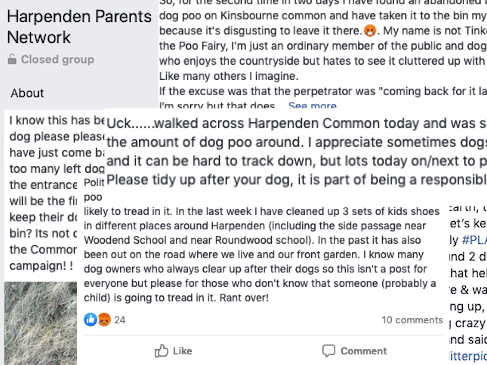
This is despite plenty of evidence to the contrary, as our accompanying video shows.  Indeed, barely a month goes by without a member of popular Facebook group Harpenden Parents Network complaining of dog faeces or – increasingly – discarded poo bags in and around the town.

Veterinary charity PDSA estimates that dog ownership has risen nationally by nearly 10 per cent over the past 8 years.  According to Keep Britain Tidy, these 8.9 million dogs produce around 1,000 tonnes of excrement every day.

37397693_10160497527165063_2628205142574366720_n

An unknown Harpenden local makes clear their position on dog poo.

Five years ago, the Government introduced increased powers for councils to issue on-the-spot fines to protect public spaces.

Many, including nearby East Herts District Council, took up these powers, fining owners up to £80 for failing to clean up their dogs’ mess.  Some have gone further.  In parts of Lincolnshire and Kent, dog walkers can even be fined for failing to have a sufficient number of bags with them.

St Albans and District Council has preferred the carrot to the stick, installing more bins and relying on dog owners to act responsibly.

Its website advises people to report anyone they see “allowing their dog to persistently foul on pavements”.  However, a spokesperson admitted the Council had received no complaints in recent memory, perhaps suggesting people do not know how to complain or have little faith their complaints will be acted upon.  It is understood the Council has no plans to change its approach.

Screen Shot 2019-07-22 at 13.43.09

Residents regularly vent their frustrations about dogs’ mess on Harpenden Parents Network.

Harpenden resident Philip Wigg, 41, said this “smacks of complacency”.

The father of three said: “Dog poo on our streets is a growing issue and a problem for hygiene and public health.  I cannot understand why the Council doesn’t exercise the powers it has at its disposal to fine dog owners who persistently refuse to clear up after their dogs.”

Enforcing a fining regime could be costly, but would also act as a revenue raiser.  For example, three councils in North Wales recently raised a combined £2.1 million over three years in dog fouling and litter fines alone.

There may also be difficulties in identifying culprits, but these are not insurmountable.  DNA testing has had some success in the US and Europe, and was trialled recently in Barking and Dagenham.  Although it relies on dog owners’ consent, it could serve to deter lazy owners from risking being apprehended.

One thing is for sure: until the Council takes firmer action, Harpenden residents will see dogs’ mess, poo bags and frustrated complaints continue to mount up.

If you see anyone persistently allowing their dog to foul on pavements, you can report this to St Albans and District Council’s Environmental Compliance Team on 01727 819406 or environmental@stalbans.gov.uk.

What’s all the fuss about?

Other than the inconvenience of scraping it off your shoe, is dogs’ mess really a problem?

Well, yes.  Canine faeces can carry worms and bacteria, which may transmit to other animals.  And, although rare, humans can contract toxocariasis from it – a nasty infection that can lead to dizziness, asthma and even blindness.

Nutrients in canine faeces can also disrupt ecological balance.  Earlier this month, East Northamptonshire Council rejected a planning application for housing partly due to fears over the effect increased dogs’ mess would have on a nearby nature reserve.