On 2 September 1997, a professional footballer named Clarke Carlise made his debut for Blackpool in a 4-3 win over Wrexham. Over the next 16 years, he went on to make 470 appearances for nine different clubs and earned three caps for the England Under 21s.
Impressing many with his intellect and eloquence, Clarke became an ambassador for football’s anti-racism Kick It Out campaign and Chairman of the Professional Footballers’ Association, alongside the inevitable media work that came his way. Clarke retired from football in May 2013 with, one presumes, money in the bank and (in contrast with many retired sportsmen) a promising future ahead of him.
On the morning of 22 December 2014, Clarke Carlisle was hit by a lorry on the A64.
His condition was critical but he pulled through, finally returning home last week. In an interview in today’s The Sun, Clarke revealed that the collision was no accident: he jumped in front of the lorry. Clarke’s lucky to be alive and it’s to be hoped that, in time if not now, he agrees.

Clarke explains that his suicide attempt “wasn’t escaping or running away” but represented, in his mind, “the perfect answer“. Despite this, there will be some who accuse Clarke Carlisle of being a coward: that taking one’s life (or attempting to) is the ultimate act of surrender.
Those people are idiots, who’d do well to shut up and pay heed to the words of Elvis Presley: “Don’t criticise that man unless you have walked in his shoes“.
I can’t pretend to have walked in Clarke’s shoes but, over the past year, I’ve worn a similar make. I’ve suffered from clinical depression and anxiety. And I continue to.
At times, I felt incapable of partaking in everyday life and racked with guilt at the knowledge I’d become a burden to my loved ones. I was also terrified that my condition was worsening and, as I fell, I couldn’t see the bottom. When these sorts of feelings are allowed to fester, it’s no wonder that some see not continuing to live as a solution.
I haven’t defeated the Black Dog but, for now, I’m winning. I never threw myself in front of a lorry but that isn’t because I was stronger or braver than Clarke Carlisle: it’s because I was lucky. The Dog bit me hard, but decided not to go for the jugular.

In many ways, I was nowhere near as brave as Clarke, who’s been open about his mental health problems for some time. In 2013, he presented an insightful BBC documentary entitled Football’s Suicide Secret which delved into an issue that few in the macho world of professional sport want to discuss. That year, he also published an autobiography which revealed he’d seriously contemplated suicide.
His announcement today should also be regarded as an act of courage because, for every Clarke Carlisle, there’s many more men and women who are scared to admit their perceived weaknesses. A stigma’s still attached to mental health problems even if, from my own experience, people are becoming more understanding and compassionate than I expected. But there are still dinosaurs about and I’m sure a fair number will make their voices heard on social media today.
These dinosaurs are only part of the problem though. The other is the segment of our brains (conditioned by the world in which we’ve been raised) that considers mental illness to be a source of shame.
Thanks to this inner critic, I’ve found it very hard to bring up my depression even with those close to me, although I’m always relieved to talk about it when prompted to do so. Even with strangers, I’ve found myself concealing it like some dirty little secret: avoiding smalltalk, making up disingenuous reasons why I’m off work, hiding the front cover of a book about depression on train journeys.
The self-judgment we project onto others makes the big wide world seem a frightening and lonely place. As the dinosaurs die out, it’s hoped that the next generation will be spared this inner critic.
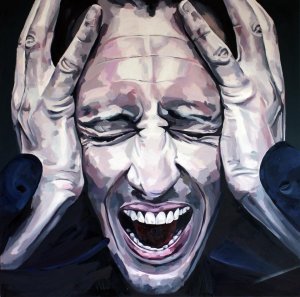
To this end, The Telegraph should hang its head in shame by choosing to headline today’s coverage of Clarke’s announcement with: “Clarke Carlisle confession: I stepped out in front of lorry because I wanted to die“. “Confession” is commonly defined as a formal statement “admitting that one is guilty of a crime“. Clearly, in this context, it’s an appalling choice of words which only reinforces the internal and external stigma the press should play its part in helping reduce.
An apology is needed, not just to Clarke, but to all sufferers of mental illness.
There will be some who say that Clarke is undeserving of an apology or sympathy: “How could someone so fit and strong, with all that money, fame and three beautiful children be so selfish?” Those people are also idiots.
Because that list of reasons for living doesn’t constitute a charge sheet against someone who tries to kill him or herself; it indicates the severity of the illness they’re suffering from. Try to imagine the mental imbalance required for someone to decide that, despite all those wonderful things in their life, it’s better for them not to carry on living.
If you can find some sympathy in your heart for an ageing bachelor who kills himself quietly in despair at life’s loneliness, it’s illogical not to locate at least as much for the tormented souls of people with “everything to live for” like Clarke Carlise, Gary Speed and Robin Williams to name but a few.
There’s a well-known proverb that conscience is “the dog that can’t bite, but never stops barking“. Next time you feel inclined to pass judgment on people like Clarke Carlisle, listen to that dog. And just pray to God it never gets a taste for blood.
 Project Refuse
Fantastic article.
Completely agree.
LikeLike